✦ ASK DR. GAYNOR | PUPPY HEALTH ✦
Puppy Exercise Guidelines by Age and Breed Size, Built on Evidence Instead of the Five-Minute Rule
How much exercise does a puppy need, explained by a board-certified veterinary specialist: why the five-minute rule has no data behind it, how growth plates and breed size set the timeline, what research in dogs, young horses, and young athletes shows, and when your puppy can safely run, fetch, hike, or ski with you.
23 minutes read | Veterinarian-Authored | Peer-Reviewed References

By Dr. James S. Gaynor, DVM, MS, DACVAA
Diplomate, American College of Veterinary Anesthesia and Analgesia | Medical Director, Black Dog Veterinary Anesthesia Services
Last Updated: October 3, 2026
Quick Answer: How Much Exercise Does a Puppy Need?
A puppy needs plenty of daily movement, but the type of activity matters far more than the number of minutes. Free play and exploring on soft, varied ground, where the puppy sets the pace and stops when tired, are appropriate from the day your puppy comes home. Sustained or repetitive exercise that you control (running or jogging with you, biking, long fetch sessions, skiing) should wait until the growth plates close, which ranges from under a year in small breeds to as long as two years in giant breeds. Keep your puppy lean, avoid stairs in the first three months, and build up gradually.
Key Takeaways: Puppy Exercise
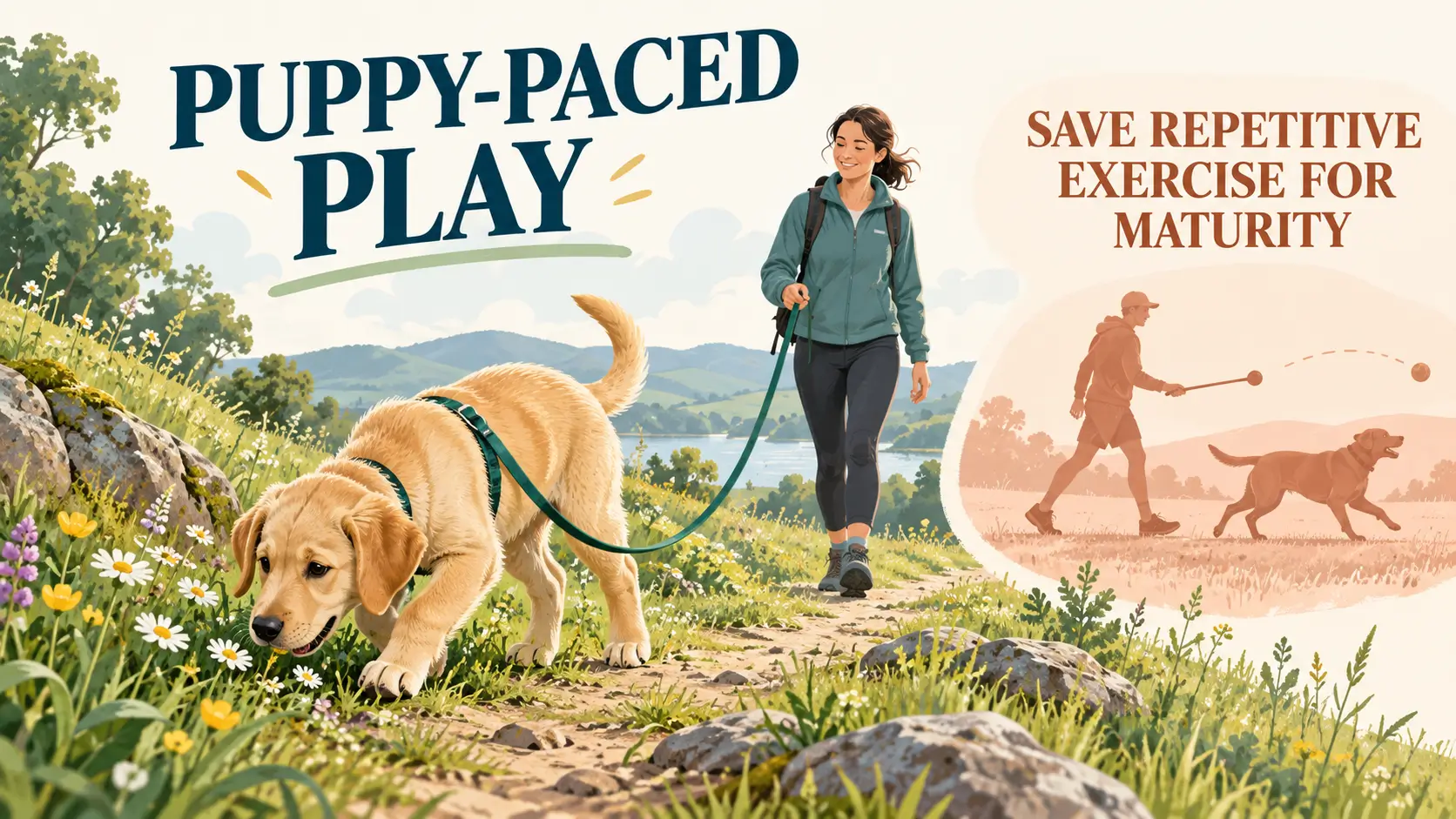
In short: research in puppies, foals, and children points to one pattern. Lots of self-directed movement protects growing joints. Confinement broken up by bursts of hard, repetitive, owner-driven exercise causes trouble.
Almost every new puppy owner I talk with asks how much exercise is too much. Most have already been handed the five-minute rule. Some worry they hurt their puppy on a long hike; others have a young Labrador bouncing off the walls because walks are rationed by the minute.
We have less puppy-specific research than any of us would like, but we are not guessing. There is useful data in dogs, and a much larger body of work in young horses and young human athletes. Lined up together, they tell a consistent story that differs from the five-minute rule. This guide walks through that evidence and turns it into practical guidance by age and breed size.
A note on the evidence.
Throughout this guide I separate what research has shown from what is my clinical judgment. Where a study exists, I name it. Where a recommendation is expert opinion, including the age-by-size tables, I say so. No article replaces an examination of your own puppy, especially for large and giant breeds or any puppy that is limping.
In This Article
The five-minute rule says a puppy should get five minutes of exercise per month of age, once or twice a day. It is easy to remember, widely repeated, and has never been tested in a study.
You will find it on kennel club sites, breeder handouts, and many clinic websites. The American Kennel Club, for example, describes walks of about five minutes per month of age, once or twice daily. As far as I can determine, no study has ever compared puppies raised under this rule with puppies raised any other way. A 2025 review in the Veterinary Ireland Journal, written by Dr. Siobhan Menzies, a veterinary pain management and rehabilitation practitioner, lists it among the misconceptions owners are commonly given.
The rule exists for a good reason: to keep owners from over-exercising growing dogs. My concern is what it leaves out.
What the Rule Assumes | What Actually Matters |
All minutes are equal. | A 20-minute sniff in a field and a 20-minute jog on pavement put very different loads on growing joints. |
The owner sets the dose. | Puppies that choose their own pace stop, rest, and change direction. Steady, owner-paced activity removes that self-regulation. |
Breed does not matter. | A Yorkshire Terrier finishes growing well before its first birthday. A Great Dane may take two years. |
Less is always safer. | Too little movement delays joint and tendon maturation (see the horse data in Section 4) and contributes to weight gain and behavior problems. |
What the rule gets right is the instinct to protect growing joints from repetitive, forced load. The rest of this guide is about doing that with more precision.
Growth plates (physes) are zones of cartilage near the ends of the long bones where lengthening happens. Until they close, they are the weakest link in a young dog’s skeleton.
A hard landing or twisting stop that would strain a ligament in an adult dog is more likely to injure the growth plate in a puppy, because that cartilage is softer than the surrounding bone and ligaments. Damage there can lead to a crooked limb or a poorly fitting joint.
Most of a puppy’s bone lengthening happens between about 12 and 26 weeks of age (Balsa and Robinson, 2016). Closure then happens bone by bone rather than all at once, and the timing depends heavily on adult size.
Adult Size | Examples | Approximate Growth Plate Closure |
Toy and small (under about 25 lb) | Yorkshire Terrier, Jack Russell Terrier, Cavalier King Charles Spaniel | 6 to 10 months |
Medium (about 25 to 50 lb) | Border Collie, Brittany, Australian Shepherd | 10 to 12 months |
Large (about 50 to 90 lb) | Labrador and Golden Retrievers, German Shepherd | 12 to 16 months |
Giant (over about 90 lb) | Great Dane, Newfoundland, Irish Wolfhound, Leonberger | 14 to 24 months |
These ranges are approximations drawn from published veterinary sources. Individual growth plates close at different ages, and radiographs are the only way to know for certain in a specific dog.
One factor owners rarely hear about is that sex hormones, estrogen in particular, help signal growth plates to close. In a controlled study at the University of Florida, dogs spayed or neutered before maturity had delayed growth plate closure compared with intact dogs, and the delay was longest in dogs altered at 7 weeks (Salmeri et al., 1991). If your puppy was altered young, add time to the estimates above.
Spay and neuter timing has its own breed-specific trade-offs for joints and cancer risk (Hart et al., 2020), and deserves a direct conversation with your veterinarian.
Only a handful of studies look directly at exercise in growing dogs. They are still far more useful than the five-minute rule, and they point in a consistent direction.
The strongest is a Norwegian prospective cohort of 501 Newfoundlands, Labrador Retrievers, Leonbergers, and Irish Wolfhounds followed from birth (Krontveit et al., 2012). Puppies with access to stairs before 3 months of age had a higher risk of radiographic hip dysplasia. Puppies that got off-leash exercise on soft ground in moderately rough terrain during the same window had a lower risk. Being born on a farm, or in spring or summer, was also protective, most likely for the same reason: more room and more weather to move around in.
Two cautions: this was an observational study in four large and giant breeds, so it shows association rather than proof, and hip dysplasia clustered strongly within litters, a reminder that genetics matters before exercise ever enters the picture.
Older experimental work in Beagles shows that dose matters. Moderate daily running made knee cartilage thicker and richer in glycosaminoglycans, one of its key cushioning components (Kiviranta et al., 1988), while very high mileage (about 40 km a day for a year) reduced glycosaminoglycan content in the weight-bearing areas without signs of cartilage degeneration (Arokoski et al., 1993). In another study, dogs walked on a treadmill about 3.75 km a day, five days a week, wearing jackets that weighed 130% of their body weight, for about ten years, and showed no harm to their joint cartilage (Newton et al., 1997). These were treadmill studies in a sturdy, mid-sized breed, but they suggest that canine joints tolerate moderate, consistent loading well.
Repetitive, high-impact activity is where concern concentrates. A Swedish study of Labrador Retrievers (Sallander et al., 2006) is commonly cited as linking regular retrieving of balls or sticks thrown by the owner, in young dogs, to a higher risk of hip dysplasia. Current rehabilitation guidance advises avoiding jarring, repetitive exercise such as intense ball chasing before joints mature.
Finally, body weight. In the Purina lifetime study, Labrador littermates were paired and one of each pair was fed 25% less from 8 weeks of age. The leaner dogs lived a median of 13.0 years versus 11.2 years and developed radiographic hip arthritis later and less often (Kealy et al., 2002; Smith et al., 2006). No exercise protocol has ever shown an effect that large.
Horse researchers have studied exercise in growing animals more rigorously than we have in dogs, because a young racehorse’s skeleton is worth a great deal of money. Their findings map remarkably well onto puppies.
In a Dutch study, 43 Warmblood foals were raised from about one week of age to weaning in box stalls, in stalls with daily gallop sprints, or on pasture with free movement. Confinement alone delayed maturation of bone, cartilage, tendon, and muscle, though most of that delay was recovered once the foals got normal turnout.
The sprint group is the important one. At 5 months their tissues looked like the pastured foals’, but by 11 months there were signs of reduced tissue performance. The researchers concluded that regular, sub-maximal loading was best, and that short bouts of heavy exercise on top of rest appeared to impair long-term resistance to injury.
I think of this as the weekend-warrior puppy. Crated most of the week while the family is at work, then taken on a long Saturday run or an hour of fetch to make up for it. That pattern resembles the sprint-trained foals, not the pastured ones.
A later project by the Global Equine Research Alliance (Colorado State University among its partners) added a gradually increasing conditioning program on top of pasture turnout, about 30% more total workload. Those Thoroughbred foals did not have more orthopedic problems than pasture-only foals, and in race training the pasture-only group tended to show musculoskeletal trouble earlier (Rogers et al., 2008).
The equine lesson for puppy owners:
a broad base of free, self-directed movement is the foundation. Modest, gradual structured exercise on top of that base is well tolerated and may even help. Intense exercise on top of confinement is the combination to avoid.
Pediatric sports medicine has something closer to a data-driven version of the five-minute rule, and it measures something different: the balance between organized training and free play.
In a clinical study of roughly 1,200 young athletes, Jayanthi and colleagues (2015) found that children who spent more hours per week in sports than their age in years had about twice the odds of a serious overuse injury, such as a stress fracture or cartilage injury. Children whose organized sport time outweighed their free play by more than two to one had nearly double the odds as well, independent of total hours. Interestingly, how fast the children were growing did not predict injury.
That second finding matters most for puppies. Free play varies the load. Children sprint, stop, climb, and change direction, then rest when they choose. Structured training repeats the same motion at an adult-set pace. The 2021 youth running consensus statement likewise recommends free play alongside running, while noting the evidence base is limited (Krabak et al., 2021).
My working rule, borrowed from this data:
until growth plates close, most of a puppy's activity should be self-directed. I aim for at least as much free play and exploring as owner-directed exercise, and ideally twice as much. This is an extrapolation from human data, not a tested canine threshold, but it points owners in a better direction than a minute count.
The most useful thing you can do is sort your puppy’s activities into three categories, because almost all of the risk sits in the third.
Category | Examples | Guidance |
1. Self-directed movement | Free play in a yard or field, exploring, sniffing walks on a long line, play with a well-matched puppy or gentle adult dog | Appropriate from the start. The puppy sets the pace and quits when tired. Soft, varied ground is best. |
2. Low-intensity structured activity | Leash walks at the puppy’s pace, training sessions, short hikes on easy trails, supervised swimming | Appropriate early on. Build duration gradually and stop before your puppy flags. |
3. High-load or repetitive exercise | Running or jogging with you, biking, ball launchers and long fetch sessions, disc catching, agility jumps, dock diving, skiing and skijoring, long hikes with big climbs and descents | Wait for growth plate closure, then build up gradually over weeks. |
Even a leash walk can drift into category three. A brisk walk on a short leash at human pace forces a puppy into a steady trot on hard ground. Let your puppy stop and sniff; a meandering walk tires the brain as well as the legs.
Here is how I advise owners on the activities they ask about most. Unless a study is named, this is my clinical judgment.
Running with you is sustained, repetitive load, usually on pavement, at a pace your puppy cannot choose. Wait until growth plates close (see Section 8), then start with short intervals on dirt or grass and build over several weeks. Dr. Jerry Klein, Chief Veterinarian of the American Kennel Club, advises no road work or jogging before 14 to 18 months, especially in large and giant breeds (AKC, 2026). Biking alongside a dog carries the same concerns, plus the dog cannot stop when it wants to.
The problem with fetch is not the running. It is the repetition, the hard braking, the twisting turns, and the leaps. Retriever puppies also will not self-limit, because the reward is too high. A few short, low throws that roll along the grass are fine. Ball launchers and long sessions are not, until the skeleton is mature.
Puppy-paced hikes on soft trails are some of the best exercise a young dog can get: varied terrain, constant balance corrections, and plenty of chances to stop. The risks are distance creep and steep descents, which load the front limbs heavily. Plan the turnaround for your puppy, not for you, and at elevation watch for heat, sun, and dehydration on exposed trails.
Skiing is one of the most demanding things we ask dogs to do. Bounding through deep snow is like running in soft sand: every stride means lifting the whole body up and out. Add cold, ice balls packing between the toes, and ski edges, which can cause serious lacerations to a dog’s legs. I treat skiing and skijoring as strictly post-maturity activities. When your dog is skeletally mature and already conditioned, start with short Nordic outings on packed trails where dogs are permitted, and build from there.
The Norwegian data make stairs before 3 months the clearest avoidable risk, so carry young puppies; after that, a few controlled trips a day are reasonable. Puppies also splay and scramble on hardwood and tile, and runners in main traffic areas are a cheap fix.
Swimming builds fitness with very little impact, which makes it one of the few conditioning activities I like for growing dogs. Start in calm, shallow water with a canine life jacket and keep sessions short. Play with well-matched puppies is self-directed exercise at its best; supervise play with much larger or rougher adults, where collisions exceed what a growing skeleton should absorb.
Future agility, field, and working dogs can start foundation work (body awareness, balance, skills on the flat) early. One practical sequence from the rehabilitation literature: simple stretches from about 8 weeks, core and limb strengthening after about 6 months, and endurance training only after growth plates close (Menzies, 2025). A veterinarian certified in canine rehabilitation can help build a plan.
The tables below are my clinical guidance, informed by the research above. They are not tested thresholds, and your own puppy’s build, health, and energy should adjust them.
Age | Encourage | Avoid |
8 to 12 weeks | Free play and exploring on soft, varied ground; short training games; lots of sleep | Stairs (carry the puppy), slick floors, jumping off furniture, long walks at your pace |
3 to 6 months | Exploration walks at puppy pace on a long line (Menzies, 2025, suggests about 15 to 30 minutes at 2 to 4 months, extending toward 45 to 60 minutes by 4 to 6 months); puppy classes; introduction to swimming | Jogging, biking, ball launchers, repeated jumping |
6 months to growth plate closure | Longer hikes at puppy pace, balance and strengthening work, short controlled fetch on grass | Sustained running, skiing, full-height agility jumps, dock diving |
After growth plate closure | Introduce running, skiing, and sport training gradually over several weeks | Going from couch to long run or big ski day all at once |
Adult Size | Earliest Age to Begin Gradual Running |
Toy and small | About 10 to 12 months |
Medium | About 12 to 14 months |
Large | About 14 to 18 months |
Giant | About 18 to 24 months |
Add a few months if your puppy was spayed or neutered well before these ages. For a large or giant breed you plan to run or ski with seriously, radiographs to confirm growth plate closure are a reasonable investment.
Exercise gets most of the attention, but several other factors carry at least as much weight for a growing dog’s joints.
Factor | Why It Matters | What to Do |
Body condition | Lean Labradors developed hip arthritis later and lived longer (Kealy 2002; Smith 2006). | Keep your puppy lean, with ribs easy to feel and a visible waist. Ask your vet to score body condition at each visit. |
Diet and calcium | Excess calcium impaired skeletal development in growing Great Danes (Hazewinkel et al., 1985). | Feed a complete puppy food formulated for your dog’s expected adult size. Do not add calcium or bone supplements. |
Genetics | Hip dysplasia clustered within litters in the Norwegian cohort. | Choose a breeder who screens parents (OFA or PennHIP for hips, and elbows where relevant). |
Rest | Tissues adapt during recovery. A young puppy may play 30 to 60 minutes, then nap one to two hours (Menzies, 2025). | Protect nap time. An overtired puppy plays harder and gets clumsier. |
Puppies are good at hiding discomfort, and they will keep playing through it. As a pain specialist, I would much rather see a puppy early.
Watch for limping (including a limp that shifts from leg to leg), stiffness when getting up after rest, reluctance to jump or climb, bunny-hopping with both hind legs together, sitting or lying down partway through walks, lagging behind, and any swelling, heat, or tenderness around a joint or along a long bone.
Growing dogs have their own orthopedic conditions. Panosteitis is most often diagnosed between 5 and 12 months in larger breeds, and hypertrophic osteodystrophy typically between 2 and 6 months (Balsa and Robinson, 2016); osteochondrosis, elbow dysplasia, and hip dysplasia also surface during growth. Not all are caused by exercise, but all are easier to manage when caught early. A limping puppy needs a veterinary visit, not a wait-and-see!
A puppy needs plenty of daily movement, mostly self-directed play and exploring on soft, varied ground. The type of activity matters more than the minutes. Sustained or repetitive exercise that you control should wait until the growth plates close.
The five-minute rule (five minutes of exercise per month of age, once or twice a day) has never been tested in a study. It is a well-meant rule of thumb, not a scientific limit.
Wait until your dog’s growth plates have closed, then start gradually. That is roughly 10 to 12 months for small breeds, 12 to 14 months for medium breeds, 14 to 18 months for large breeds, and 18 to 24 months for giant breeds.
A few short, low throws on grass are fine. Long sessions and ball launchers are not, because the repeated sprinting, hard braking, twisting, and leaping load growing joints and growth plates.
Only after skeletal maturity and a base of conditioning. Bounding through deep snow is one of the most demanding activities a dog can do.
Limping, stiffness after rest, reluctance to jump or climb, bunny-hopping, lagging behind, or lying down on walks all suggest your puppy is doing too much or has an orthopedic problem.
American Kennel Club. When does my puppy finish growing? 2026.
American Kennel Club. How much exercise does a puppy need? Mental and physical exercises. 2024.
Gaynor JS, Muir WW (eds). Handbook of Veterinary Pain Management, 3rd Edition. Mosby/Elsevier, 2015.
Dr. James S. Gaynor is a board-certified veterinary anesthesiologist and pain management specialist with more than three decades of clinical and academic experience in anesthesia, acute and chronic pain, mobility, and quality-of-life medicine. He is a Diplomate of the American College of Veterinary Anesthesia and Analgesia, Medical Director of Black Dog Veterinary Anesthesia Services, and Chief Medical Officer of Peak Therapeutics, and he sees patients at Buffalo Mountain Animal Hospital in Dillon, Colorado. He co-edited all three editions of the Handbook of Veterinary Pain Management (Mosby/Elsevier) and has authored more than 60 peer-reviewed publications. He is also author and co-editor of Cannabis Therapy in Veterinary Medicine (Springer).
Education
BA, Biology, The Colorado College, Colorado Springs, CO, 1983
DVM, The Ohio State University, Columbus, OH, 1988
Anesthesiology Residency and MS (Cardiac Physiology), The Ohio State University, Columbus, OH, 1992
Board Certifications and Credentials
Diplomate, American College of Veterinary Anesthesia and Analgesia (DACVAA), 1993
Board Certified, Academy of Integrative Pain Management, 2004
Certified, International Veterinary Acupuncture Society, 1999
Certified Veterinary Pain Practitioner, International Veterinary Academy of Pain Management, 2011